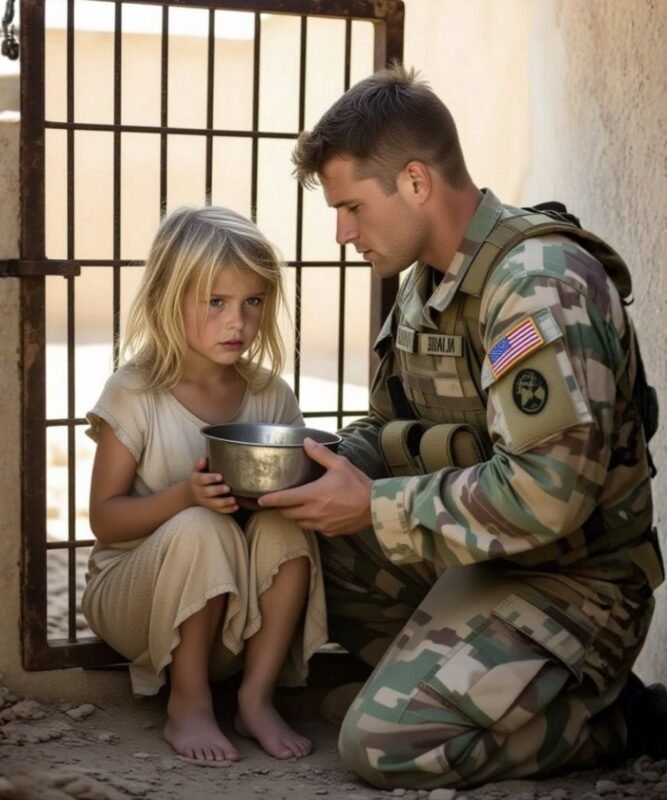
The knock on the garage door was silent—more like the creak of a weak hand than a cry for help. I had just gotten out of the car; the dust from fifteen months in Afghanistan still clung to my uniform.
My boots had touched American soil only three hours before, and already I felt something was wrong. The house was eerily quiet. No laughter. No music. No sound from my little girl, who usually ran to greet me.
I opened the side door—and froze.
There, crouched on the cold concrete, was my seven-year-old daughter, Emily.
Her blond hair hung tangled, her thin arms and legs were covered in inflamed blisters—mosquito bites, dozens of them. Dirt and dried tears traced furrows on her cheeks.
„Dad,” her hoarse voice trembled, „Mom’s friend said this is my place.”
The bag fell from my hand, my heart pounding in my chest. The scene—fragile, trembling, starved of light and air—was more horrifying than anything I’d seen on the mission. I grabbed her.
She weighed frighteningly little, her body thin against my chest.
„You’re not alone anymore, honey. You’re safe.”
I wasted no time. I carried her to my van and drove straight to the base’s medical station. The paramedic froze when he saw her condition.
Emily held my hand as she was examined—her eyes wide, filled with fear, as if even the walls might betray her.
While someone was tending to her, I went outside and made just one call. Just one. To an old comrade. A man who owed me more than one favor.
That same night, everything that was once our home changed. My friend would learn what it means to go against a soldier who, for a year, had only dreamed of returning home.
My wife—Lisa—called just before midnight, her voice shrill, panicked, screaming words I could barely make out.
But it didn’t matter anymore.
I returned, ready to face the nightmares—and found a war far more personal than any gunfire abroad.
Fifteen months of fighting had prepared me for many things—but not betrayal. Not the heartbreaking screams of my little girl. Not the battlefield within our four walls.
Her call had stopped, her troubled voice still ringing in my ears.
But the truth was already written—in Emily’s trembling body. No apology from Lisa could erase the image of our daughter, locked up like an animal.
I stood outside the medical station, fists clenched, gazing at the night sky. The crickets chirped quietly, almost mocking me with their steady rhythm.
I had escaped the bullets for fifteen months—and yet the battle there was harder. Because the enemy wasn’t wearing a uniform.
I drove home again. Every mile weighed on me. Memories returned—Emily laughing as she learned to ride a bike, the smell of Lisa’s freshly baked cake, the warmth of her kisses on the doorstep.

Now everything was poisoned, tinged with the taste of betrayal.
When I stopped, the porch light was on. Through the window, I saw him—Mark. Thirty-something, confident, a beer in his hand, sprawled on my couch as if it were his own home.
Lisa stood before him, her shoulders hunched, her eyes flickering toward the window, when my car’s headlights illuminated the awning.
I approached the house, my steps pounding with the steady rhythm of a soldier entering enemy territory. I knocked once, loudly. The door opened. Mark was there.
„Look who’s back,” he said ironically, raising the bottle. „Have you come to get what’s yours?”
Something inside me broke—but discipline held me upright. I went inside and closed the door.
“And where will Emily sleep tonight, Mark? Always in the garage?”
His mocking smile disappeared—just for an instant. Then he leaned over. “This child needed discipline. Lisa agrees with me—right, sweetheart?”
Lisa’s lips moved, but no words came out. She looked small, guilt written all over her face.
I took a step forward, my voice low and menacing. “Discipline doesn’t mean leaving a child hungry. It doesn’t mean locking him up like he’s nothing. It’s over for you.”
He laughed—emptily, without conviction. “And what will you do, soldier? Will you shoot me?”
There was no need. My presence was enough. “Get lost. Tonight. Or the people I called will make sure you get lost.”
Fear flashed in his eyes. He looked at Lisa, but she turned away, tears streaming down her face. She grabbed her keys, muttered something unintelligible, and ran out. The door slammed so hard the frame rattled.
The silence that followed was oppressive. I turned to Lisa.
„Why?” My voice cracked. „Why did you let that take his life?”
„He was saying things,” Lisa sobbed. „He was saying that Emily was spoiled, that I was weak.
and—”
I interrupted her, my anger growing. “She’s our daughter. And you let her destroy her trust.”
Lisa collapsed, crying into her hands. In that moment, I felt nothing.
I didn’t stay that night. Emily was now safe with me, and my duty was clear. The war had followed me home. And it wasn’t over.
Morning came upon the divided house. I hadn’t slept a wink. I was in the guest room of the barracks, where Emily finally fell asleep in my arms, her little hand clutching the cuff of my sleeve.
Every time she sighed in her sleep, I stroked her hair and promised her she’d never feel that fear again.
The Army had trained me to fight—but not in family court. Two days later, I was sitting with a lawyer, a former JAG officer who knew the system inside out.
“It’s negligence. Abuse. With the medical reports and witness testimony, the court won’t side with Lisa.”
And we had it all. The paramedic had documented weight loss, dehydration, the countless injuries—which told their story.
Testimonies were taken, documents filed. Suddenly, I wasn’t just a soldier anymore—I was a father fighting in court.
Lisa defended herself. She cried on the witness stand, claiming she’d been manipulated, that she hadn’t realized how serious it was. Her lawyer painted me as an absent father, who preferred war to family.
These words hurt, but I stood firm. My service was for them—for Lisa, for Emily, for our home.
The judge listened carefully.
But when Emily spoke—her voice small, trembling, but clear—the battle was over. „He left me to sleep in the storage room because he said I didn’t deserve Dad’s room. Mom allowed it.”
The room fell silent. Lisa cried, but the decision was final. Custody was awarded to me.
That evening, I walked out of the courthouse with Emily hand in hand. Unarmed, unarmed—but that victory was the hardest battle I’d ever fought.
The next few months were tough. Nightmares tormented her, her screams pierced the nights. She was frightened by loud voices—even mine. It broke me, but I learned patience.
I learned to speak softer, to rebuild trust. Gradually, she healed. She began drawing again—the two of us in the park, smiling figures in the sun. When she laughed again, genuinely, I knew we were going in the right direction.
Lisa was granted limited visitation rights. At first, Emily refused. Over time, I encouraged her. „She’s still your mother,” I told her gently. But I never forced her. That bond was theirs—if it could ever heal.
Today, I often sit on the porch and watch Emily chase fireflies. Then I think about the night I found her in the garage. The anger still simmers, but love guides me.
I’ve fought wars abroad for my country. But the greatest battle of my life took place here—for my daughter’s future. And this time, I won.