
Do you always know where to find me? In my garden. I love gardening.
There is something incredibly rewarding about caring for plants, watching them grow and seeing all your hard work pay off. But let’s be clear: it’s also quite a challenge.
One of the main problems is pests.
Often, people don’t even know which insects are helpful and which ones can ruin all their efforts.
I recently came across a photo on social media that perfectly captures this confusion.
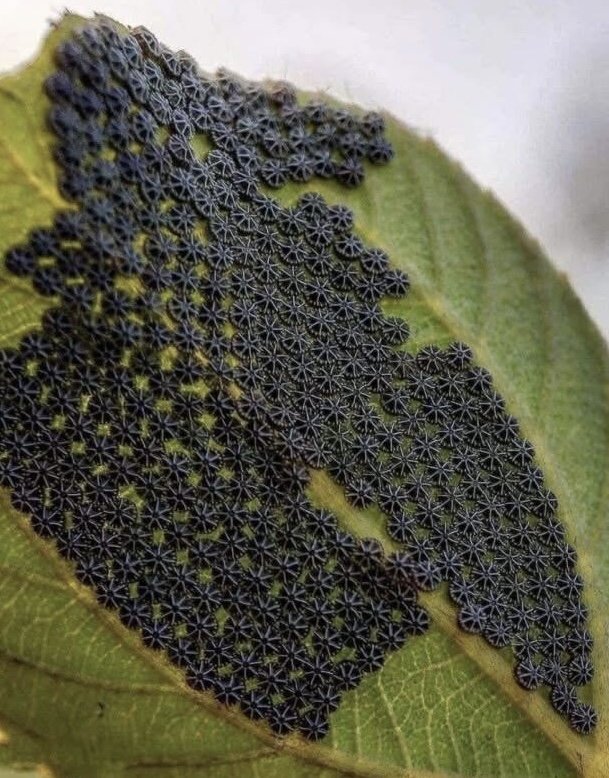
When I first saw it, I was surprised. The photo showed a leaf covered in tiny black geometric patterns.
At first glance, it looked like the leaf had been attacked by a strange web or a rare disease. Many people, including me, wondered what it could be.
After a little research, I discovered that the mysterious patterns were actually eggs of the painted lady (*Nymphalis antiopa*).
If you’re not familiar with this species, let me tell you about it. It is a fascinating insect, with a particular life cycle and very interesting habits.
The eggs of the Vanessa antiopa. The photo I saw was a close-up of these eggs on a leaf.
They almost looked like delicate black lace scattered across the surface of the leaf.
Once you get over the initial shock, it is truly a beautiful sight. The eggs are laid in groups, and each of them is a small geometric masterpiece.
I thought: „This could be a very good thing for my garden, or a disaster.” Fortunately, the Vanessa antiopa is a rather useful species.
Its caterpillars feed on leaves, but generally prefer trees and shrubs such as willows, elms or poplars.
So, if you have a garden full of flowers and vegetables, you can sleep soundly.
Observing the life cycle of this butterfly is a real pleasure. After these tiny eggs hatch, the caterpillars are born.
They are black, with small white spots and covered in spiny bristles. They go through different stages, called moults, during which they shed their skin and grow.
When they reach the right size, they look for a safe place to pupate. They create a cocoon – a sort of small sleeping bag – in which the transformation takes place.
This phase can last from a few weeks to several months, depending on the climate and the season.
When they finally emerge from the chrysalis, they become beautiful painted lady butterflies, with dark, velvety wings, edged in bright yellow and dotted with blue spots.
One of the most fascinating characteristics of the painted lady butterfly is its ability to overwinter.
Unlike many other species, these butterflies spend the winter in a state of hibernation, taking refuge under bark, in piles of wood or even in old sheds.
In spring, they are among the first butterflies to appear, often even before the flowers bloom.
It is precisely this early appearance and the dark, melancholic wings against the backdrop of the spring landscape that inspired their name „antiopa” (Polish: „żałobnik”, meaning „in mourning”).
Natural balance in the garden. As gardeners, we often focus on the immediate effects of the presence of insects.
We see caterpillars and think: „Oh my God, they will eat everything!” But it is worth looking at things from a broader perspective. The Vanessa antiopa is a perfect example of how nature seeks balance.
Yes, caterpillars may eat a few leaves, but they will not destroy the entire garden. In fact, by providing them with a space to live, you contribute to a healthier ecosystem.
What to do if you find eggs or caterpillars?
My best advice? Leave them alone. Enjoy the process and watch their transformation.
If you’re concerned about your plants, you can gently move the caterpillars to a tree or shrub, where they’ll be happier and less likely to damage your flowers.
Gardening is an art of balance—harmony between the plants you love and the creatures that share that space with you.
The next time you see something strange in your garden, take a moment to observe before reaching for a pesticide. You might discover something surprising, like I did with the painted lady’s moth eggs.
In the end, it’s all part of the adventure. Each season brings new surprises and challenges, and that’s what makes gardening so rewarding.