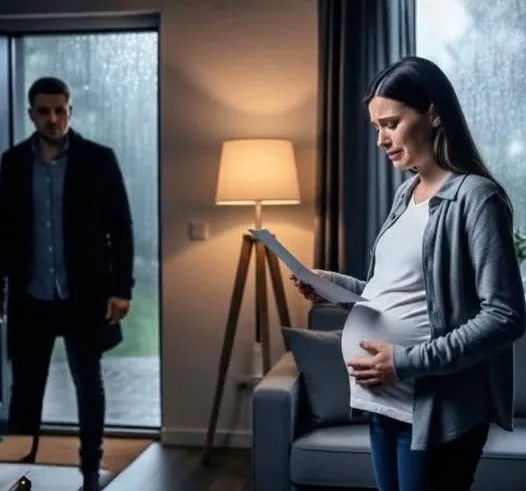
“I’m sorry,” my husband whispered, avoiding my eyes.
I could barely breathe as I held the test results in trembling hands.
“Are you sorry?” I repeated, my voice breaking.
He nodded, grabbed his coat, walked out the door… and never looked back.
That night, the silence in the house weighed more heavily than the diagnosis itself.
The tiny life growing inside me stirred gently, as if to remind me I wasn’t alone.
Tears blurred my vision. “Everything will be alright, little one,” I whispered, placing my hand on my belly. “We’ll get through this together.”
The next morning, I woke to the sound of my father’s car pulling into the driveway.
He didn’t wait for me to call him: he just knew. Dad was always like that.
When he saw my pale face and swollen eyes, he didn’t ask any questions.
He just hugged me. “We’ll get through this together,” he said, his voice firm and warm.
That same day, he took me to the hospital for my checkup.
In the waiting room, he held my hand, told corny jokes to make me laugh, and carried my bag like it was a treasure.
When I tried to apologize for being a burden, he interrupted me:
“You’re my little girl,” he said. “And this baby… you two are my world now.”
Weeks passed. My husband never called. But my father was there every day.
He made sure I ate, took my medicine, and rested.
When the treatments caused me to lose my hair, he took me to the barber and convinced me to shave our heads together.
“At least we’ll match,” he joked. And when I saw his shiny head next to mine, I laughed for real for the first time in months.
When I went into premature labor, he was the one who took me to the hospital in the middle of the night, half asleep but determined.
During the contractions, he held my hand, wiping away my tears with his thumb. “You’re stronger than you think,” he whispered.
Hours later, when my son’s first cry filled the room, Dad cried too.
He was the one who held him first. His rough, tired hands trembled.

“Welcome to the world, little one,” he said tenderly. “Your mom is a true warrior, and you are our miracle.”
The following weeks were hard. The treatments continued, and many times I was too weak to hold my baby for very long.
But Dad took over without hesitation. He rocked him to sleep, changed diapers with clumsy tenderness, and hummed lullabies in his deep, calm voice.
One night, I was awakened by noises in the living room.
Dad was sitting in his old armchair, with my son asleep on his chest. The lamp’s soft light bathed the scene in an almost sacred calm.
„Don’t worry, champ,” I heard him whisper. „Your grandpa’s here. Your mom is the bravest person I know.”
I turned around, and felt tears roll down my cheeks, but this time not from sadness… but from gratitude.
Months later, when they told me the disease was in remission, Dad baked a cake—a little burnt, a little crooked, but perfect.
We laughed until we cried, while my little one sat between us.
Sometimes I still think about that night my husband passed away.
I used to wonder what I did wrong, or how love can fade so quickly.
But today I understand: family isn’t made up of those who stay when everything is easy, but those who don’t leave when everything falls apart.
My father didn’t just save my life.
He gave my son a hero to look up to, and taught me that love can heal even after the darkest diagnosis.