The Millionaire, His Daughter, and the Lesson Money Can’t Buy
Don Esteban García was one of the wealthiest men in the city, the kind whose name opened doors and whose decisions moved fortunes. His mansion was a sanctuary of luxury: gleaming marble floors, crystal chandeliers that hung like cascades of light, and walls covered with paintings worth more than an average house.
And yet, amidst such abundance, there was something money couldn’t buy him: peace.
His wife had died years before, leaving him alone with his daughter Isabella, a ten-year-old girl as brilliant as she was spoiled, raised among servants, tutors, and privileges she had never appreciated.
In recent months, Don Esteban had changed nanny six times. All of them had left in tears, unable to bear the little girl’s unbearable temperament.
A New Arrival
One Monday morning, a new employee arrived: a quiet woman named María. She dressed simply, and her face reflected a lifetime of work. When Isabella was introduced to her, she smiled sweetly, but the little girl barely glanced at her.
„I hope she lasts longer than the others,” Don Esteban said, half jokingly, half resignedly.
„I’ll do my best, sir,” María replied calmly. „Children just need someone to understand them.”
For a few days, everything seemed peaceful. María carried out her duties without raising her voice: she cooked, cleaned, and took care of Isabella’s room with dedication. She didn’t complain, not even when the girl ignored her or deliberately made a mess of everything.
But the calm was soon shattered.
The Outbreak
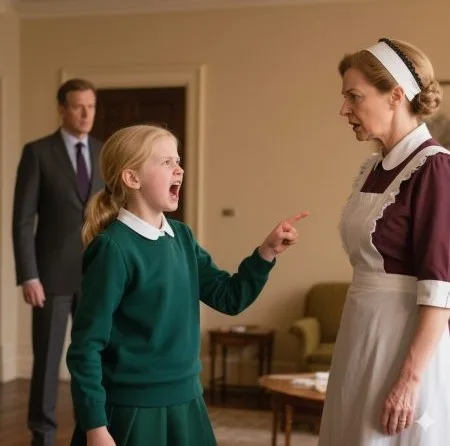
One afternoon, Don Esteban returned home earlier than usual. He had barely crossed the threshold when he heard shouts coming from upstairs.
„You’re useless!” Isabella yelled. „You don’t even know how to fold my clothes!”

He rushed upstairs and found Maria standing there, her eyes brimming with tears, as the little girl confronted her angrily. On the bed lay a pile of perfectly folded clothes; the “mistake” had been putting them in the wrong drawer.
“Isabella!” Don Esteban thundered. “That’s enough!”
The little girl froze. Maria wiped her tears and murmured calmly,
“It’s alright, sir. She didn’t mean any harm.”
But Don Esteban saw the pain in her eyes.
“Go to your room,” he ordered his daughter firmly. “Right now.”
When Isabella stormed off, slamming the door, the man turned to Maria.
“I apologize. You don’t deserve to be treated like this. I’ll speak with her.”
Maria hesitated for a moment.
“Sir… can I say something to her first?”
He nodded.
“I also had a daughter, Isabella’s age.” We lived in the countryside. She was sweet, respectful… she dreamed of studying, but I could never afford her schooling. When she got sick, I didn’t have the money to take her to the hospital… and I lost her.
A tear rolled down his cheek.
“I accepted this job because I miss taking care of children. I don’t blame Isabella—she’s still learning. But please, don’t just punish her. Teach her to understand.”
A Father’s Conscience
That night, Don Esteban couldn’t sleep. María’s words echoed in his mind. He had believed that giving his daughter everything—clothes, toys, trips—would be enough to make her happy. He hadn’t realized that he had raised her without empathy, always taking refuge in his business.
The next morning, he called her into the living room, with María present.
“Isabella,” he said calmly, “starting today, there will be some changes.”
“Am I being punished?” she asked suspiciously.
“No,” her father replied. “You’ll spend a week helping Maria. You’ll clean, cook, and learn what she does for us every day.”
“That can’t be true!” the girl protested.
“I’m serious,” Don Esteban retorted. “If you want to live in this house, you’ll have to learn respect.”
The Change
The first day was a chaotic mess of complaints and sour faces. Isabella swept poorly, broke dishes, and complained about everything. But Maria never lost her patience. She taught her gently, correcting her with a smile.
On the third day, the girl began to ask questions.
“Did your daughter help you too?” Maria smiled sadly.
“Yes. She always said that helping made her happy.”
Something changed in Isabella’s heart. That night she ate dinner in silence, without whims or demands. For the first time, she gave thanks for the food.
By the end of the week, she was no longer the same. She retained her joy, but her pride had vanished. In its place, a new sensitivity had been born.
The Apology
On Sunday morning, Isabella approached Maria with a small box in her hands. Inside was a pink ribbon.
„It was my mother’s,” she said softly. „I want you to have it. And… I’m sorry for how I behaved.”
Maria’s eyes filled with tears.
„Thank you, dear,” she whispered, embracing her.
From that day on, Maria ceased to be a mere employee: she became part of the family. And Don Esteban, seeing them together, understood that true wealth is not measured in gold or luxuries…
…but in the humility of
Learning the value of change and the kindness that unites one heart with another.
Moral: Respect cannot be bought. True wealth lies not in what we possess, but in the compassion and gratitude we offer.