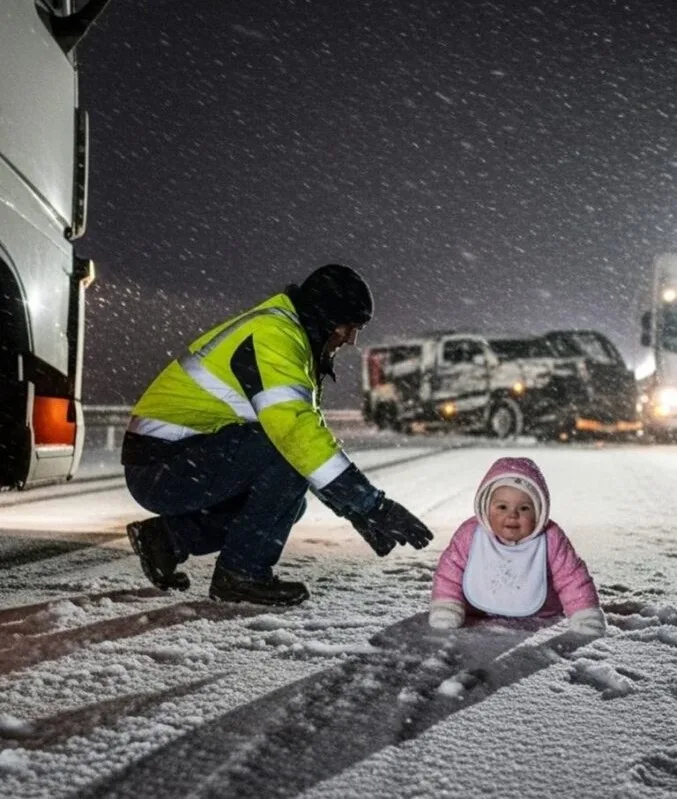
The White Shadow in the Headlights
It was one of those winter nights that absorb all sounds. The road was deserted, the sky low, and the snow fell slowly, like sleepy feathers. After twelve hours behind the wheel, a long-haul trucker advanced between mounds of snow with the patience of someone who knows he can’t fight the ice. His home was only a few miles away.
Then, the world shrank to a white figure in his high headlights: small, moving, almost unreal.
He slowed down carefully, the ABS throbbing under his foot. The truck shuddered and stopped—a meter from a small body on the road.
A One-Year-Old in the Nowhere
He opened the door and got out into the snow. The wind cut his face. There, on the center line, a child—no more than a year old—crawled, wearing a white bib over light pajamas, without a hat or gloves, his bare feet pressing against the ice like coins on glass. His cheeks were flushed with cold; his lips trembled; his breath formed small wisps of vapor.
“Oh, God…” she murmured, lifting him into her arms. He was incredibly light—and colder than a child should be.
The Detail That Transformed Fear into Alarm
She wrapped him in her jacket, pressing him to her chest for warmth. Then she saw it: something that chilled her stomach.
In the flashing lights, tiny fragments glittered on the baby’s sleeve and palm. It wasn’t snow. It was glass. And on his wrist, a hospital bracelet with today’s date, a last name, and a recent time.
A child on the road. Glass on his skin. A brand-new bracelet.
Everything indicated that what had happened was recent—and not far from here.
The Decision in the Dark
She began dialing 112 with her free hand, giving the operator the exact mile marker and uttering the words no one expects to hear: “There’s a newborn on the road. He’s alive, but frozen. I see glass on his skin. I think there’s been an accident.”
“Keep the baby with you,” the operator said. “Keep him warm. Don’t hang up.”
She removed the thermal parka and wrapped it around the baby, then covered him with the emergency blanket. His tiny fingers closed weakly around the collar of the jacket.
“I’ll take care of you,” she murmured. “You’re safe.”

The Hidden Footprint in the Snow
A gust of wind lifted the curtain of snow and revealed what the road had tried to swallow: a broken crack in the snowplow barrier, faint skid marks toward the shoulder, and a series of shallow footprints—small hands, knees—crossing the lane like a trail leading from the gap in the guardrail.
If the child had crawled all the way there, something—or someone—was further down.
“I think there’s a vehicle on the slope,” she told the operator. “I’m going to check it out. I won’t leave her alone.”
She hugged the baby close to her jacket, zipping it up against her chest, and with her free arm moved toward the barrier.
The Ravine
The beam of the headlight illuminated an awkward silhouette, half-buried in fresh snow, steam escaping from the dented hood. An SUV lay on its side in a shallow ravine. Hazard lights off. No other vehicles, no voices. Only winter and the ticking of a hot engine cooling too quickly.
“Vehicle located,” he said. “No flames visible. Get down.”
She slipped, grabbed hold, climbed down, her boots sinking into the ice. In front of the passenger window—a web of cracks—she covered her hands and peered inside.
A woman hung suspended by her seatbelt, the deflated airbag beside her like an empty lung. Pale forehead, closed eyes, a thin thread of condensation fogging the windshield with each breath.
„Ma’am! Can you hear me?”
She blinked slightly. A small gesture.
Two Lives, One Moment
He remembered the lessons from a safety course years ago: keep your airway clear, don’t twist your spine, stabilize what you can, and call for help if you can’t.
„I have your baby,” he said, loud and clear. „She’s okay—she’s with me.” A faint sound—half a sob, half disbelief—escaped the woman’s lips.
The dispatcher’s voice was still in his ears: „The units are four minutes away. Can you keep her awake?”
„I’m here,” the woman whispered, lost. „Where… where is she?”
“Hold me close and warm,” he replied. “With me. Help is coming.”
He rested his shoulder against the broken glass, supported the woman’s head with his forearm, and kept talking—about the snow, the truck’s lights, the blanket that would cover them when help arrived. Most of all, he kept her awake.
Pressed against his chest, the baby stirred, a tiny spark of warmth against the cold.
Red and Blue on White
Sirens wailed like a distant anthem, then filled the ravine with color—red and blue on the snow. EMTs rushed in: one team with the mother using a cervical collar and cutting her seatbelt, another with the baby in pediatric gear and warm packs.
“Temperature low but rising
„Good tone. Loud cry,” someone said. Words that sounded like a blessing: loud cry.
After securing the mother, they lifted her on the stretcher toward him. „Sir, we have them both. Are they okay?”
He only noticed his hands trembling when a paramedic took the baby and saw his fingers—red from the cold, not blood—instinctively close in his palms, reluctant to let go.
What the Night Had Tried to Hide
Later, when the road was marked and the SUV righted, a police officer explained the scene: black ice on the curve, loss of control, skidding through the barrier. The rear window had shattered; the infant car seat had been jolted, but the seatbelt held long enough to cushion the baby’s fall. Disoriented, tiny, and alive, she had crawled toward the only light she could see: the faint tape of the road.
The chemical smell that startled him? Mist from the ruptured radiator’s coolant, harmless, but proof that time was measured in minutes, not hours.
The hospital wristband confirmed the rest: mother and daughter had been discharged after a routine checkup that night. The storm arrived faster than expected. The wrong mile at the wrong time—and the right driver at the exact right moment.
The Call That Counts
Two days later, his phone rang with an unknown number. A woman’s voice—sweet, more confident—filled his kitchen.
„It’s me,” she said. „From the ravine.”
He gripped the edge of the counter and closed his eyes. „How is she?”
„Rosy cheeks. Normal appetite. No frostbite.” A laugh heavy with relief. „I’ll be okay, too. I don’t remember much after the glass, but I remember your voice. I remember you wrapping me up.”
He swallowed. „I’m glad you remember that part.”
“Can we get you anything?” he asked hesitantly. “A note? A cake? It doesn’t seem like enough, but…”
“It’s more than enough,” she said gently. “Just—when she’s older, tell her she crawled toward the light and you found her.”
What Remains
As he drove through that winter corridor again, he slowed down out of habit. The guardrail had a new panel; the snowplow barrier was intact. He stopped for a minute, flashing lights against the snowdrifts, and sat with the engine ticking.
He realized then: the horror wasn’t the glass, the cold, or the endless darkness. The horror would have been to keep going.
He stopped. That was the whole story.
After the Snow
The policeman would later tell him a silent statistic: on winter roads, what saves lives isn’t luck, but a chain of small, correct decisions. Headlights low in the deep snow. Distance between vehicles. A driver who trusts a flash and brakes before their brain can process it.
Sometimes, the smallest life needs the biggest truck to stop.
The Lesson of the Night
Look twice at what doesn’t belong. A „shadow” at midnight could be a life at stake. Bring warmth: a blanket, an extra jacket, and the willingness to give them. Call first, act prudently, stay with them. Calm saves seconds; presence saves hope.
Believe in the small signs: a hospital bracelet, a line of footprints, glass in a sleeve. They point to the truth that the darkness hides.
And if you’re ever on a silent highway, with snow swallowing sounds and time, remember the truck that stopped a foot away and the baby who crawled toward the light. Kindness, like flashing lights in a storm, doesn’t end winter, but it makes the road passable—long enough for help to arrive and for morning to find them both alive.