Every afternoon, around two or three, the phone rang. It was my daughter Kavya, who had given birth just ten days earlier and was undergoing quarantine at her husband’s house in Bhawanipur, Barabanki district. Her broken voice pierced my soul:
„Mom, I’m exhausted… I’m scared… Come get me, I can’t take it anymore…”
Hearing her, my heart broke. I looked at my husband, Sri Shankar, who only sighed:
„Calm down. It’s normal for your daughter to cry, newly married and locked away with her in-laws. Don’t dwell on it.”
But I couldn’t. Every night the phone vibrated with her desperate sobs. And I, clutching my chest, cried too, while the fear of what people would say kept me motionless.
Until one morning I decided I couldn’t bear it anymore. I shook my husband and, in a firm voice, said:
„I’m going to get her right now. And if they don’t let me in, I’ll take her no matter what.”
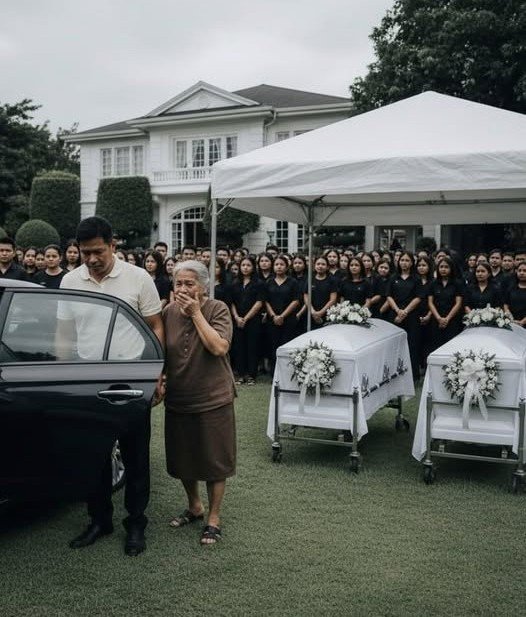
We left Lucknow, traveling at top speed for more than thirty kilometers. When we reached the red-roofed house, my eyes blurred: in the courtyard, two coffins covered with white sheets and marigold wreaths lay side by side. Incense smoke rose from the small temple, while a funeral trumpet pierced the air.
My husband, his voice breaking, exclaimed:
„My God… Kavya!”
My daughter had died in the night.
And next to her coffin, a small white coffin held the body of my still nameless granddaughter. Pain wrenched a cry from me:
„How many times did you call me, daughter? How many? And I didn’t come to save you?”
The neighbors murmured:
„She wanted to go to the hospital, but her in-laws wouldn’t let her out: the Sutak wasn’t finished. They gave her herbs to stop the bleeding. By the time it got worse, it was too late…”
I trembled, paralyzed. Kamala Devi and Mahendra, my in-laws, avoided my gaze, murmuring: „Old ways.”
Faced with those two bodies, I realized that my world was crumbling because of blind traditions and the cruelty of a family that denied my daughter the care she needed.
„Stop the cremation! I want the truth!” I shouted as I ran toward the coffins.
Kamala Devi tried to push me away:
„According to custom, they must be taken immediately to the river…”
I tore off the sheet in fury:
„What tradition allows a woman who has just given birth to die without anyone calling an ambulance? What tradition prevents a mother from saving her daughter?
I dialed 112. The operator’s firm voice answered:
„The nearest unit will arrive shortly.”
I also called 181. A few minutes later, the Ramnagar police stormed the courtyard. Sub-Inspector Verma ordered the ceremony to stop.
„Where are the medical records? Who did you call last night? Did you call an ambulance?”
Rohit, Kavya’s husband, sweated silently, looking at his mother. Kamala stammered:
„The Sutak… He couldn’t get out. The midwife gave him leaves…”
„Name?”
„Shanti… from the last house.”
I showed them my phone:
„Here are all my daughter’s calls, night after night, pleading for help.”
Verma nodded and ordered both bodies to be taken to the Barabanki morgue for autopsy.
The hospital director tenderly explained:
„Based on the symptoms, it was postpartum hemorrhage. With oxytocin, fluids, and urgent transfer, the outcome could have been different.”
I could barely breathe. The missed calls, the sobs on the other side of the closed door… everything pierced me like knives.
The officer filed a complaint for negligence, dangerous acts, and cruelty to the newborn. He also ordered a judicial inquiry into maternal death.
In the afternoon, the midwife, Shanti, was brought in to testify, her bag full of roots and powders.
„I just treated her like a daughter…” she muttered.
„A postpartum hemorrhage can’t be cured with leaves or superstitions,” the officer replied.
Shanti lowered her gaze, lost in guilt and bewilderment.
Click here
I looked at her, no longer angry, just exhausted:
„Tradition should save lives, not become the knife that prevents us from reaching the hospital.”
That same night, I returned to Lucknow to collect the pregnancy papers: the maternity notebook (ANC letter), the previous month’s ultrasound, and a note warning about the „risk of PPH.” The sheets, their edges yellowed with age, bore the signature of the doctor upstairs stating that the delivery should take place in a room equipped to control hemorrhage. I hoisted the bag with those documents over my shoulder and collapsed in front of the door.
Sri Shankar picked me up in his arms, and for the first time, I saw him cry like a child.
The next morning, the preliminary autopsy report arrived: massive hemorrhage and cardiac arrest; in the newborn, respiratory failure and probable hypothermia due to lack of care. Verma informed me:
„We will send the herbal samples for analysis. Rohit, Kamala, Mahendra, and Shanti have been summoned. Cremation will not be permitted until the SDM completes the paperwork.”
I clutched the edge of the chair.

and I replied:
„I’ll take my daughter home for the ceremony. No one will stop her.”
Verma nodded:
„According to the CrPC, biological parents can lodge a complaint if the husband’s family is under investigation.”
When the coffins arrived in Lucknow, neighbors lined the silent road. No one spoke; they brushed the corners of the lid with trembling fingers, like someone unwilling to wake from a dream. Sunita carefully placed a red scarf—Kavya’s favorite color—on the coffin. I knelt and placed her phone in her hand: the missed call from that same afternoon was still visible on the screen. Each call was now a voice bearing witness.
During the prayer, the priest said quietly:
„Tomorrow we will take this case to the Women’s Commission. We will ask for the removal of senseless prohibitions and the implementation of mandatory postpartum medical care. Kavya’s pain must not die twice in silence.
There was a preliminary hearing before the Barabanki SDM. Rohit, his voice breaking, lowered his head and said:
„I was afraid, Mom. I thought the neighbors would laugh at me if I took her to the hospital during Sutak… I was wrong.”
I looked him in the eye and said:
„If you were wrong, you will pay for the truth. Sign this: from now on, every home birth must be performed in a hospital. Apologize—there is no shame in calling 108.”
The SDM registered it and announced that he would send the resolution to the Panchayat and the neighborhood association for dissemination.
Mrs. Kathryn was silent for a long time; then she handed me the keys to the house:
„I don’t deserve to keep them. When the fire dies down, Kavya’s wedding photo will be in the main hall.”
I closed my eyes. The tears were no longer fury: they were tiredness turning into resolve.
That afternoon, I returned to the banks of the Gomti. The golden sky reflected two threads of smoke drifting across the water, still, as if the storm hadn’t yet arrived. Mr. Shankar held his wife’s hand firmly. I heard my daughter’s voice in the wind, repeating those nightly calls:
— „Mom, I’m so tired… I’m scared…”
I whispered to the river, as if sending a message to infinity:
— „Rest in peace. Mom will keep going until the end.”
On my way back, I passed by the health center. Sunita hung a new sign:
— „After birth: don’t be alone. Call 108.”
Below, numbers 112 and 181 were also listed. I took a copy and decided that waiting wouldn’t be enough: I would go door to door in Bhawanipur with Sunita and the women’s association. Every door closed that night was to be opened the next time a mother needed help.
That night, I placed Kavya’s photo in the most sacred place in the house and lit a small lamp. The flame didn’t go out. I told my children and grandchildren:
„Tomorrow I will file another complaint, gather evidence, and start a campaign: ‘Don’t close the door when a mother asks for help.’ Our pain will serve to protect other mothers.”
I know that part three will involve going beyond the kitchen: putting an emergency number in each pocket, teaching people how to knock without fear, and ensuring that no mother ever hears her daughter crying behind a closed door in the middle of the night again. Do you want me to adapt it to an even more literary tone, or would you prefer me to leave it like this, with this testimonial tone?