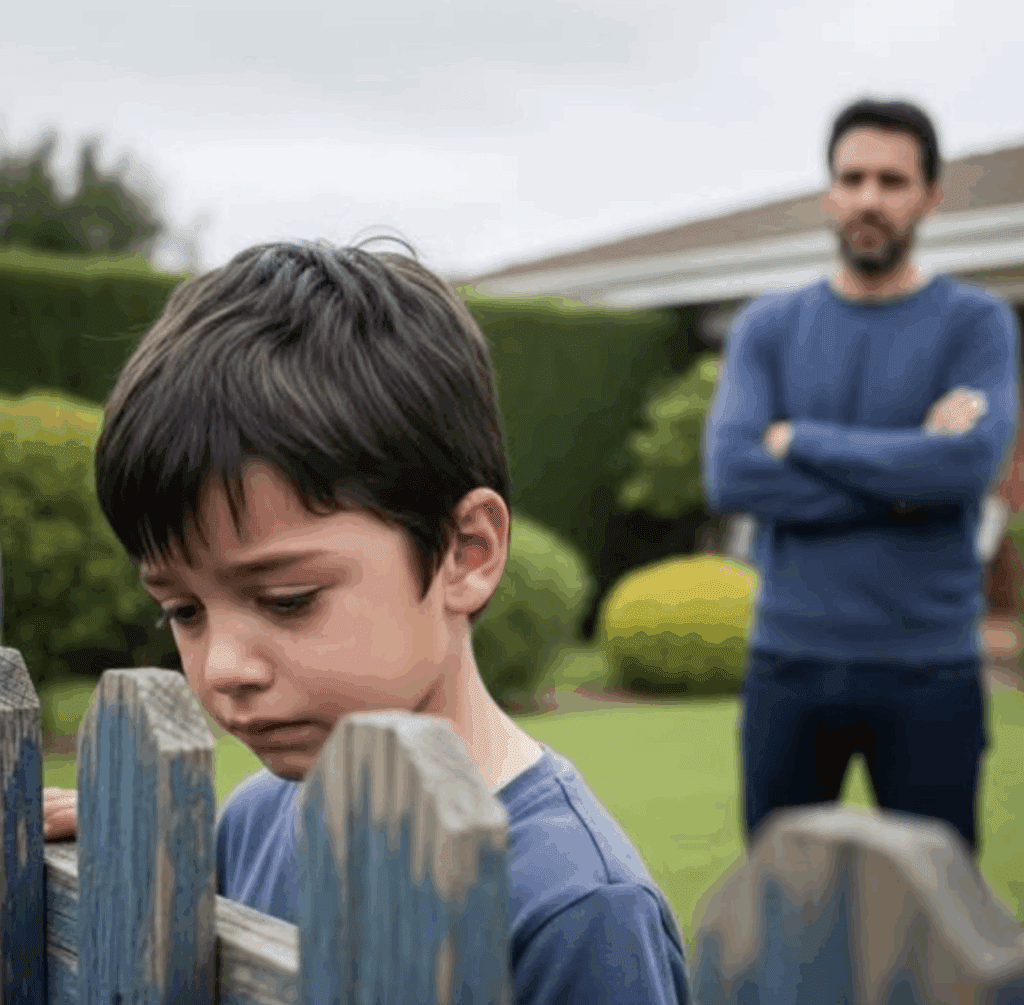
“Go away. You are not my son. My wife is dead. I have no obligation to care for you. Go wherever you want.”
He didn’t cry.
He didn’t beg.
He just lowered his head, picked up his torn backpack, and walked away silently—without saying a word.
Ten years later, when the truth came to light, I wished more than anything I could turn back time.
My name is Rajesh, and I was thirty-six when my wife, Meera, died suddenly of a stroke.
She left behind not only me—but also a twelve-year-old boy named Arjun.
But Arjun wasn’t my biological son.
He was Meera’s son from a previous relationship.
When I married Meera, I was twenty-six. She had already been through a lot of pain—a lost love, a pregnancy lived alone, a life filled with silence and shame.
Then I admired her strength.
I told myself that accepting her—her and her son—was a noble gesture.
But a love born of duty, not of the heart… cannot last.
Raising Arjun was, for me, just an obligation—nothing more.
Everything fell apart when Meera died.
There was no longer any bond that united me to that boy.
Arjun had always been silent, respectful, reserved.
Perhaps, deep down, he knew I had never truly loved him.
A month after the funeral, I finally said to him:
“Go away. I don’t care if you live or die.”
I expected him to cry. To beg me.
But he didn’t. He walked away.
And I… felt nothing.
I sold the house and moved elsewhere.
Life went on. Business was good.
I met another woman—with no past, no children.
For years, I sometimes thought about Arjun.
Not out of affection—out of curiosity.
Where was he? Was he still alive?
With time, even that curiosity faded.
A twelve-year-old boy, alone in the world—where could he have gone?
I didn’t know. And I didn’t care.
I even said to myself:
„If he’s dead, maybe it’s better this way. At least he’s not suffering anymore.”
Ten years later.
I received a call from an unknown number.
„Hello, Mr. Rajesh? Could you attend the opening of the TPA Gallery on MG Street on Saturday?
Someone really hopes to see you there.”
I was about to hang up, but the next sentence made my blood run cold:
„Don’t you want to know what happened to Arjun?”
My chest tightened.
That name—Arjun—I hadn’t heard in ten years.
I hesitated. Then I replied curtly:
“I’ll come.”
The gallery was modern, crowded.
I entered and felt out of place.
The paintings were extraordinary—oil on canvas, cold, unsettling, full of distance.
I read the artist’s name: T.P.A.
Those initials struck me like a bolt of lightning.
“Good evening, Mr. Rajesh.”
Before me stood a tall, thin young man, simply dressed, his gaze deep and penetrating.
I froze.
It was Arjun.
He was no longer the frail boy I had chased away.
Before me stood a confident, successful man. Familiar—yet foreign.
“You…” I stammered. “How…?”
He interrupted me, his voice calm and sharp as glass:
“I just wanted you to see what my mother left behind.
And what she chose to abandon.”
He led me to a canvas draped with a red cloth.
“It’s called *Mother*. I’ve never shown it before.
But today I want you to see it.”
I lifted the cloth.
And I saw her—Meera.
On the hospital bed, pale, frail.
She clutched a photograph—the three of us, on the only trip we’d taken together.
My knees buckled.
Arjun’s voice didn’t tremble:
“Before she died, she wrote a diary.
She knew she didn’t love me.
But she believed that, one day, she would understand.
Because… I’m not another man’s son.”
I gasped.
“What…?”
“Yes. I am her son.
She was already pregnant when you met.
But he told her he was someone else’s child—to test her heart.
Then it was too late to tell the truth.”
“I found the truth in her diary. Hidden in the attic.”
My world fell apart.
I had pushed my son away.
And now he stood before me—proud, strong, accomplished—while I had lost everything.
I had lost my son twice.
And the second time… forever.
I fell into a corner of the tunnel, destroyed.
His words echoed in my mind like blades:
“I am your son.”
“She was afraid I would stay only out of duty.”
“She kept quiet… because she loved you.”
“You ran away… because you were afraid of responsibility.”
I once thought I was noble for ‘accepting another woman’s child.’
But I had never been good. Or just. Or a father.
When Meera died, I pushed Arjun away like something useless.
Not knowing he was my blood.
I wanted to speak.
But Arjun had already turned away.
I ran after him.
“Arjun… wait… If I had known—if I had known you were my son—”
He turned around. Calm. But cold.
“I didn’t come for your apology.
I don’t need you to acknowledge me.
I just wanted you to know—Mom never lied.
She loved you. And she chose silence… so that you could choose, freely, love.”
I couldn’t say anything.
“I don’t hate you.
Because if you hadn’t kicked me out…
maybe I wouldn’t have become the man I am today.”
He handed me an envelope.

Inside—a copy of Meera’s diary.
In his shaky handwriting:
> “If you read this someday—please forgive me.
> I was afraid.
> Afraid you only loved me for the baby.
> But Arjun is our son.
> From the moment I knew I was pregnant, I wanted to tell you.
> But you began to doubt, and I was afraid.
> I hoped that if I truly loved him, the truth wouldn’t matter anymore.”
I cried. Silently.
Because I had failed—as a husband. As a father.
And now… I had nothing left.
I tried to make amends, but it wasn’t easy.
In the months that followed, I looked for Arjun.
I wrote to him, waited for him in front of the gallery.
Not to be forgiven—just to be close to him.
One day he agreed to see me.
His voice was soft, but firm:
“You have nothing to atone for.
I don’t judge you.
But I don’t need a father.
Because the one I had… chose not to have me.”
I nodded. He was right.
I handed him a savings book—all I had.
I had once considered leaving it to my new partner, but after discovering the truth, I ended that relationship the next day.
“I can’t change the past.
But if you let me… I’ll stay close to you.
In silence. Without title. Without pretensions.
It’s enough for me to know you’re okay.”
Arjun looked at me for a long time.
Then he said:
“I’ll accept it.
Not for the money.
But because Mom believed you could still become a good man.”
Time—the one thing you can’t get back.
I was no longer a “father.”
But I followed his every step.
I silently invested in his gallery, introduced him to collectors, offered him business contacts.
I couldn’t get my son back.
But I refused to lose him again.
Every year, on the anniversary of Meera’s death, I went to the temple.
On my knees, before her photograph, I cried:
“Forgive me. I was selfish.
But I will spend the rest of my life trying to make amends.”
When Arjun turned twenty-two, he received an invitation to exhibit in an international show.
On his personal page, he wrote just one sentence:
“For you, Mom. I did it.”
And underneath—for the first time in
ten years—he sent me a message:
“If you have time… the exhibition opens Saturday.”
I remained still.
The word “father”—so simple—yet capable of ending pain… and opening the beginning of something new.