Early homecoming.
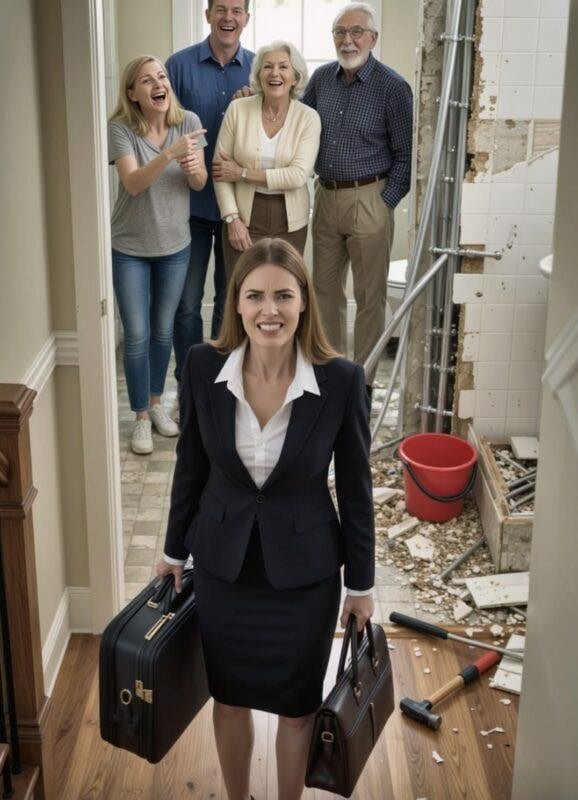
I landed on Wednesday—two days earlier than expected. I had a simple plan: skip the hotel, go straight from the airport to my house, and lie down in my comfortable bed.
The ride home was silent, filled with thoughts of a hot shower and the safety of my living room.
But when I opened the door, the first shock was the noise.
Hammers. Drills. Laughter.
And then the view.
My toilet—my real toilet—lay like garbage in the hallway. The bathroom was ransacked, cables dangling, tiles missing.
In the kitchen, cabinets were torn from the walls, pots and pans scattered on the floor. The air was thick with dust.
And in the midst of it all: my sister Emily, her husband Rick, and her parents—smiling, as if it were a family project.
Emily looked at me detachedly. „We’re renovating before we move.”
Rick smiled teasingly. His father laughed loudly. His mother giggled, too, her gloves stained with paint.
I didn’t yell. I didn’t ask what they expected.
I just said, „Okay.”
They thought I’d give up. They thought I was weak. But „Okay” wasn’t consent. „Okay” was a strategy.
The Story Between Us
It wasn’t always like this.
As children, Emily clung to me tenaciously. When her parents worked late, I cooked for her, drove her to school, helped her with her homework.
I paid for her education, paid off her debts, even paid for her wedding when her in-laws couldn’t. She called me „second father.”
But the gratitude faded. The sense of entitlement grew.
After her parents died, the house became my property—paid for thanks to her father’s years of work in the factory. Emily asked, „Just for a little while, until we get our act together.” I agreed.
But that „for a little while” became permanent.
Rick started acting like he owned the place. His parents parked in my driveway, as if it were theirs. Builders’ brochures appeared on the tables. Business cards from construction companies arrived in the mailbox.
Emily suddenly took a keen interest in when I left for work.
One evening I spied on her and heard her whisper, „He won’t resist. He’s soft. We’ll take him.”
In that moment, I understood.
But I didn’t explode. That’s exactly what they were expecting. Instead, I braced myself. I checked the deed—just my name.
I updated the insurance policy. I filed discreet claims for non-compliant construction. I documented everything: every nail, every broken tile.
So when I stood in that devastated hallway and said, „Okay,” it wasn’t surrender. It was a declaration.
The Net Tightens
That night, I didn’t sleep a wink. I gathered evidence, took photos, put legal documents in a folder thick enough to weigh down my desk.
In the morning, I called—the city building inspector, the police, my lawyer.
At 9:07, Emily called, her voice shaking. „There are five patrol cars outside. What did you do?”
I pictured her laughing, turning to panic, as the officers waded through the dust. Neighbors emerged onto their properties and whispered.
„This is my house,” I told her. „You broke the law.”
When I returned from a quick outing, the street was full of blue lights. Emily ran toward me, pale and shaking. „You—did you call the police?”
I looked her in the eye. „No. The law called them.”
Behind her, Rick was yelling at the inspector, his voice cracking. “We were just improving the house! We’re family!”
The inspector held his clipboard like a verdict. “Illegal construction. Damage to property. Trespassing. Fraud.”
Every word hit like a hammer.
Rick’s father howled in defense of family rights. An officer interrupted: “You don’t own this property. You damaged it.”
Rick’s apologies melted away; his arrogance vanished. Emily whispered, “You could have just talked to us!”
I responded coldly: “How did you talk to me, before you knocked down my walls? Before you planned to move?”
His silence said it all.
When the officers finally ushered them out of the house, the laughter faded. The evidence—photographs, reports, debris—spoke louder than I ever could.
Aftermath
Three days later, Emily called me again, her voice sharp. „You humiliated us.”
„No,” I replied carefully. „You’re the ones who humiliated yourselves. I just let the truth breathe.”

„Rick’s parents are furious. They want to sue.”
„Go ahead. The deed is in my name. The reports prove everything. They’ll pay the fines.”
A few weeks later, I met Rick at the home improvement store. His light step was gone. He glared at me. „You’ll regret this. We’ve
I fixed the house.”
“You removed the plumbing without permission. You left the wiring exposed. That’s not fixing—that’s dangerous,” I replied.
The law had already crushed his pride.
Shortly afterward, the inspector called me. “Mr. Carter, the fines are official. Your sister, your husband, and your parents are responsible. Over forty thousand.”
“Let them pay every penny,” I said calmly.
When Emily texted me a pleading message—“Please, we can’t afford this. You can’t do this to us”—I replied with a single sentence:
You asked for it.
Then I blocked her number.
Aftermath
The word spread beyond our street. Old family friends called uncertainly: “Is it true, David? Did Emily try to take your house?”
“Yes,” I replied. “And I won’t let it happen again.”
Rick’s parents stopped going to church. The neighbors whispered, the friends cooled. They were no longer victims—they had been exposed.
Meanwhile, I was rebuilding. Around that time, my lawyer filed a civil suit. The insurance company held them responsible. Every day, their silence grew louder and more desperate.
Because forgiveness without responsibility is not mercy—it’s weakness. And I was no longer weak.
Justice served
After three months, the bills had exceeded fifty thousand. Rick lost his mind, yelling at Emily in the driveway: „You told me your brother wouldn’t fight back! That you’d fix everything!”
Shortly afterward, Rick left her. His parents disappeared. Emily was left alone.
One night, he came to my door, his eyes red, and whispered: „Please. Rick’s gone. My parents are throwing it in my face. I can’t take it.”
“You didn’t think of me,” I said, “when you laughed as you destroyed my house.”
“I thought you’d forgive me, like always,” she sobbed.
“That’s the problem. You thought I was weak.”
I closed the door.
In court, the weight of evidence was irrefutable. Photos. Reports. Expert notes. Verdict: Emily ordered to pay restitution and costs.
She sat in the dock—pale, trembling, alone.
Justice didn’t taste like triumph. It felt like relief.
Rebuilding Peace
The news spread quickly. Neighbors stopped pitying her. Employers avoided her resume. Friends didn’t call.
I, on the other hand, rebuilt the house. New kitchen. New bathroom. Every repair solid, done well. My house was whole again—mine and untouchable.
The neighbors peered in, shaking their heads. „She got what she deserved.”
I just nodded.
One evening I was standing in the new bathroom, in the same spot where my toilet had been in the hallway months before. The memory of her laughter still lingered in the air, but now the tiles shone clean.
Then I understood—revenge wasn’t in the trials or the fines. Revenge was being able to stay there and know they’d never take her away from me.
Sometimes people ask if I regret it.
Do I regret calling the police? Of erasing my sister from my life?
I always answer the same thing: I don’t regret justice. I’m sorry I trusted too easily. But regret isn’t weakness. It’s a lesson.
Today, when I leave, I close the door with a clear conscience.
Because I know—if someone tries it again, I won’t hesitate.
And it doesn’t matter if I return two days early or two days later—I’ll return to silence.
Not to emptiness. To freedom.
Because that night, when I said „OK,” I didn’t consent.
I declared war.
And I won.
The end.