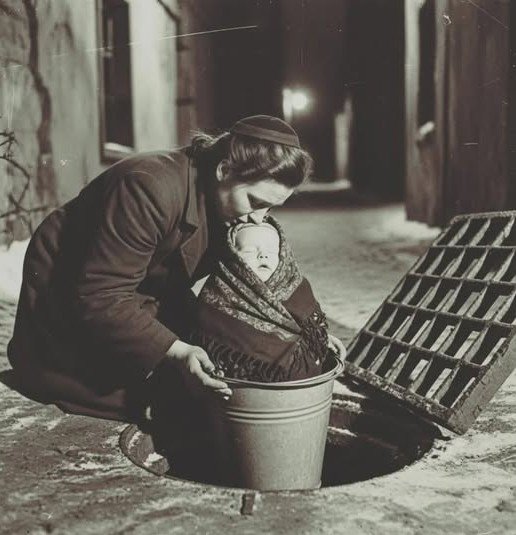
The old man’s name was Jakob Krüger. He had been born in the spring of 1942, though no one in the ghetto had marked the day itself. His mother had reckoned the weeks by the shrinking of her own body and the swelling of his. When the bucket brought him down, he weighed less than a flour-sack. When he came back to Lviv in the winter of 1998, he bore the world on him.
Jakob had come back not as a wanderer seeking sights, nor as a soul seeking forgiveness, but as a witness. He carried no camera, no note-book, only the red rose and a small tin box holding three things: a scrap of the shawl that once wrapped him, a photo of the sewer-man who had saved him—taken in 1957, the man already old and smiling crookedly—and a letter he had written to his mother every year on the night he slipped into the dark. He had never sent any of them. They were marked “Mother, Somewhere Beneath Lviv,” and sealed with wax that had cracked and mended itself a hundred times.
He had flown in from Toronto, where he had lived since 1949—first in a camp for the uprooted, then in a rooming-house on Bathurst Street, then in a brick bungalow with a maple tree that turned blood-red each October. He had wed a Polish-Canadian nurse named Halina, raised two daughters who spoke Yiddish only when they were wroth, and built radios for a living—small, neat things that bore voices over seas. He had never told his wife the full tale of the bucket. He had never told his daughters why he flinched at the smell of wet stonework. Some nights he woke gasping, sure he was still sliding down the manhole, the rope burning his mother’s hands.
But the rose called for its journey. The tin box called to be opened. The city—changed, rebuilt, renamed time after time—called for its reckoning.
1
Jakob checked into the Hotel Zhovkva, a gray Soviet hulk on the edge of the old town. The desk girl, with purple stripes in her hair, asked if he needed help with his bag. He smiled and said no, he had borne heavier things through darker steadings. She did not ken what he meant, but she gave him Room 412 anyway, a corner room with a sight of the opera house and, beyond it, the faint shape of the ghetto’s ghost.
That first evening he walked. He walked until his knees—swapped out twice, once in ’78, once in ’91—sang with ache. He walked past the new glass cafés where students wrangled over word-weavers like Derrida, past the stone for the Ukrainian Insurgent Army, past the yellow tram that clanged like a warning bell. He walked until cobbles yielded to the cracked blacktop of Pidzamche, the borough where the ghetto had once stood.
Nothing was left. Not a wall, not a gate, not even the line where the wire once ran. Only a plaque, half-hidden in weeds, that said in Ukrainian and English: “Here stood the Lviv Ghetto, 1941–1943. Let memory be our shield.”
Jakob knelt. He set the rose on the manhole cover he had found earlier that day—rusted, paint-bitten, still in use. A bus hissed to a halt above it; folk stepped over his mother’s grave without knowing. He did not mind. The world had always trod over her.
He opened the tin box. The shawl-scrap smelled of nothing now, only time. The photo of the sewer-man—his name had been Mykola Petrenko—showed a man with a face like a nicked axe, eyes that had seen too much and still chose to see more. Jakob brushed the likeness with a thumb thickened from years of soldering.
Then he drew out the topmost letter, the one written in 1997, the year Halina died. He had never spoken it aloud. His voice, when it came, was a dry whisper against the thrumming street.
Mother, I am fifty-five. I have outlived you by thirty years, maybe more. I still do not know your name. I have asked every archive, every survivor, every liar who claimed to recall. They all shrug. “A woman with a baby,” they say. “So many.” But there was only one you. I built a life on the yield of your sacrifice. I taught my daughters to say “thank you” in seven tongues. I fixed radios so strangers could hear their mothers over the sea. I never learned to swim—water still feels like treason. I am coming home. Not to the ghetto, which is gone, but to the place where you let go of the rope. I will bring you a rose. Red, like the thread you once told Mykola to look for in my blanket, the one you stitched with your name-mark so someone, someday, might know. I found the thread. It is all I have of your hands. Wait for me at the bottom of the dark. Your son, Jakob
He folded the letter, slipped it back into the tin, and shut the lid. Then he stood, knees cracking, and walked back to the hotel. The city lights blinked on, one by one, like wary stars.
2
The next morning he hired a guide—not a trained one, but a student named Olena, writing her study-work on the sewer rescues. She was twenty-four, sharp-eyed, and not cowed by stillness. She met him in the lobby wearing heavy boots and a sweater that said, “History Is a Deed.”
“You’re the bucket baby,” she said straightaway. Jakob blinked. “I reckon I am.”
“My grandfather knew Mykola Petrenko. He said the man never took coin, only bread and hush. Said the baby cried once, then stopped—like he ken’d the stakes.”
Jakob felt the breath leave his chest. “Take me to Mykola’s grave.”
They took a marshrutka north to Yaniv Fieldyard, a wide stretch of skewed crosses and Soviet stars. Olena led him past the newer plots to a corner where the grass grew wild. The stone was plain: MYKOLA PETRENKO, 1902–1968. Under it, someone had carved a tiny manhole cover.
Jakob knelt again. This time he had no rose, only the photo. He set it face-up on the grave. “Thank you for catching me,” he said in Ukrainian, the words rusty but whole. “Thank you for not letting go.”
Olena stood back, feigning interest in a nearby stone. When Jakob rose, she asked, “Do you want to see the sewers?”
He wavered. The thought of going under-ground again made his gut tighten. But he nodded. “Yes. But not as a sightseer. As a son.”
ed. “I reckon I am.”
“My grandfather knew Mykola Petrenko. He said the man never took coin, only bread and hush. Said the baby cried once, then stopped—like he ken’d the stakes.”
Jakob felt the breath leave his chest. “Take me to Mykola’s grave.”
They took a marshrutka north to Yaniv Fieldyard, a wide stretch of skewed crosses and Soviet stars. Olena led him past the newer plots to a corner where the grass grew wild. The stone was plain: MYKOLA PETRENKO, 1902–1968. Under it, someone had carved a tiny manhole cover.
Jakob knelt again. This time he had no rose, only the photo. He set it face-up on the grave. “Thank you for catching me,” he said in Ukrainian, the words rusty but whole. “Thank you for not letting go.”
Olena stood back, feigning interest in a nearby stone. When Jakob rose, she asked, “Do you want to see the sewers?”
He wavered. The thought of going under-ground again made his gut tighten. But he nodded. “Yes. But not as a sightseer. As a son.”

3
They went in through a upkeep hatch behind the song-house, the same path Mykola had taken, though the tunnels had been widened and lit with flickering LED lamps. The air was wet, metal-like, alive with dripping water. Olena bore a hand-light; Jakob bore the tin box like a holy keepsake.
They walked for twenty minutes, boots splashing through shallow pools. The walls were marked with fresh scrawlings—names, dates, a stenciled yellow trident. Olena pointed out stead-marks: here a six-kin family had hidden for three days; there a boy had drowned when the water rose. Jakob listened, but his eyes hunted for something else.
Then he saw it. High on the bent brick wall, nearly wiped away by many years of wetness, a faint red thread had been worked into the mortar. A small cross-stitch, no longer than a finger. Two first-runes: R. L.
His mother’s mark.
He reached up, shaking. The thread was brittle, but it held. He leaned his brow on the wall and wept—wordless, shoulder-shaking sobs that rang down the tunnel like a second babyhood. Olena waited, hand-light lowered, giving him the dark he needed.
When he could speak, he said, “This is where she let go.”
Olena nodded. “The workers used to say the mothers would tie a colored thread to the blanket so the child could be known later. Most were lost. Yours wasn’t.”
Jakob took a small pair of snips from his pocket—Halina’s stitch-scissors, the ones she had used to hem their daughters’ school clothes. Slowly, with awe, he cut the thread free. It came away in one piece, still red, still unyielding. He wound it around the photo of Mykola and set both in the tin box.
4
That night he could not sleep. The inn-room felt too clean, too still. He opened the tin again and spread the letters across the bed—fifty-five of them, one for each year he had lived without her. He laid them in time-order, a lifeline of paper. Then he began to write a new one, this time on inn paper.
Mother, I found your thread. It was waiting, right where you left it. I am holding it now, between my fingers, the way you once held the rope. I have chosen to stay in Lviv a while longer. There is a school here, a Jewish day school, and they need someone to teach radio mending. The children are loud and bold. They ask things I never dared to ask. One of them, a girl named Rivka, has your eyes—though she cannot know it. I will teach them to build sets that can pull a voice out of hiss. I will teach them that stillness is not the lack of sound, but the presence of listening. And when they ask why I flinch at manholes, I will tell them the truth: because once, a mother loved her child enough to lower him into hell so he could climb out into heaven. I will not send this letter either. Instead, I will leave it in the sewer, wrapped around your thread, sealed in a plastic bag so the water cannot take it. Maybe another child will find it someday. Maybe they will ken. You grew where you could not. Now I will grow where you could not. Your son, Jakob
5
He stayed six months. He taught the children to solder, to tune, to listen for the faint heartbeat of a signal buried in noise. He led them on wanderings to the sewer mouth—not to frighten them, but to show them what bravery looks like when it has no watchers. He told them about Mykola, about the bucket, about the red thread. He did not say his mother’s name because he still did not know it, but he taught them to say “thank you” in Yiddish, Ukrainian, Polish, and in the speech of roses laid on rusty iron.
In spring, the city thawed. The song-house held a gathering for Holocaust Remembering Day. Jakob was asked to speak. He stood on the stage in a suit Halina had chosen for their youngest daughter’s wedding, the tin box in his pocket like a second heart.
He told the tale simply. No show, no tears. Only the bare truth: a mother, a bucket, a sewer, a life. When he ended, the hall was still for a full minute—a stillness so whole it felt like the ghetto itself holding breath. Then a child in the front row stood and set a red paper rose on the stage. Another followed. Then another. By the end, the stage was a garden.
6
On the last day of his leave-pass, Jakob went back to the manhole one last time. The city had set up a new plaque beside it, paid for by the schoolchildren’s coin-gathering. It read:
IN MEMORY OF THE MOTHER WHO LOWERED HER SON INTO DARKNESS SO HE COULD FIND LIGHT. “GROW WHERE I CANNOT.” —Lviv Jewish Day School, Class of 1999
Jakob knelt, opened the tin, and took out the plastic-wrapped letter. He added one more thing: a tiny radio he had built with the children, no bigger than a matchbox, tuned to a wave that played only hiss and, if you listened keenly, the faint echo of a lullaby Halina used to hum.
He lowered the bundle into the sewer on a red string—silk this time, bought from a market stall run by an old woman who reminded him of Mama Tolu from another tale. When the bundle slipped into the dark, he did not let go at once. He held the thread f
or a long breath, feeling its weight, its pull, its love.
Then he let go.
The string was gone. The hiss went on.
7
Jakob flew home to Toronto the next morning. His daughters met him at the airport, fretting over his thinness, his wordlessness. He hugged them longer than he ever had, breathing in the smell of their hair—soap and town and life. That night he sat on the porch of the bungalow, the maple tree bare against the April sky, and opened the tin one last time.
It was empty.
He smiled, a small, inward smile. The thread, the photo, the letters, the radio—they were all where they belonged now, in the dark beneath Lviv, growing into something greater than memory.
He shut the lid and set the tin on the porch rail. A breeze stirred the maple boughs, and for a heartbeat he thought he heard it: a whisper, faint as hiss, warm as a shawl.
“Grow where I cannot.”
Jakob shut his eyes. “I did, Mother. I am.”