
It all began one summer afternoon when my Uncle Richard suddenly called me.
I hadn’t heard from him in a while, but that was nothing unusual.
My Uncle Richard was the kind of person who preferred solitude. A man of few words, he had always been extremely independent, even with age.
But when I answered the phone, there was something in his voice that surprised me.
“Lucy,” he said, his voice weak, “I need you to come. There’s something I need to tell you.”
I hurried over to him, my mind racing.
My Uncle Richard had always been a very private person, so hearing him ask for help felt strange.
When I arrived, I found him sitting in his favorite armchair by the window, visibly paler than usual.
His eyes, usually piercing, looked lifeless, and he didn’t get up to greet me as he usually did.
“Uncle, what’s going on?” You don’t look well,” I said, my concern growing.
“I have trouble with my eyesight,” he replied, his voice low and shaky. “I think it’s getting worse.”
I sat down next to him, trying to hide my shock.
My Uncle Richard had always been full of life. The thought of him struggling with something like this was hard to swallow.
“Have you been to the doctor?” I asked.
“Unfortunately not,” he admitted. “I don’t know what they’re going to say. But I think it’s time to stop pretending that everything’s okay.”
I spent the next few weeks helping my Uncle Richard around the house. Every day his condition seemed to get worse.
His eyesight, he said, was failing, and he had trouble doing even simple things like making a cup of coffee or reading the newspaper.
At first, I didn’t question anything.
He seemed genuinely upset. But as the weeks went by, I started to notice things that weren’t right.
He suddenly lost his way to the bathroom, but I found him standing there, motionless, as if waiting for someone to lead him.
He dropped his cane in the kitchen and pretended to be lost, as if he didn’t know where it was.
Sometimes I caught him looking at things discreetly, when he thought no one was looking.
I became increasingly suspicious, but didn’t want to jump to conclusions.
I thought maybe he was simply going through a difficult time.
But the more time I spent with him, the more his behavior seemed… staged.
I started to pay more attention, looking for signs that he might not be really blind.
It wasn’t until one fateful evening, a month after his “blindness,” that I caught him red-handed.
I was sitting on the couch reading when I heard a noise from the kitchen.
It was strange, so I quietly got up to investigate. What I found made me freeze.
There stood my Uncle Richard, in the middle of the kitchen, his eyes wide open, looking at the shelves as he reached for a jar of jam.
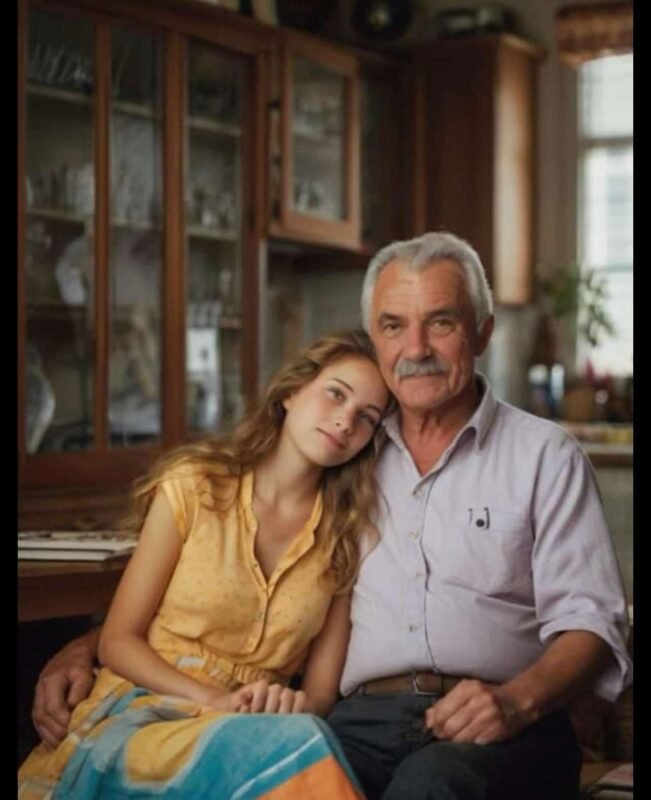
He stopped when he heard me, his face red with guilt.
“What are you doing?” I asked, my voice full of incomprehension.
He hesitated for a moment before lowering his head slowly, his expression difficult to interpret. “I suppose you understand.”
I didn’t know what to say. “Were you pretending?” I managed to ask, my mind racing.
My Uncle Richard sighed deeply and sat down at the kitchen table, his face tired and aged.
“I’m sorry, Lucy. I didn’t want to do this. But I had to know who would really take care of me.”
“Who would be there for me when I really needed help?” »
I felt a mixture of emotions: betrayal, confusion, and a strange sense of understanding.
« What do you mean? Why would you pretend to be blind? »
He looked at me with a heavy gaze.
« I’ve thought a lot about my will, Lucy. I have no one in my life who really cares about me.
I wanted to see who would be willing to take care of me, to really take the time to be there when I needed help.
I’ve lived my life working hard and taking care of myself, but as I get older I want to know who I can really trust.
I’ve seen some people in my family avoid me, and it’s been bothering me. »
It hit me like a punch in the gut.
My Uncle Richard had put us all to the test – his family, his friends – to see who would be there when I needed it most.
He wanted to make sure that those who truly loved him would inherit his assets when the time came.
“But why didn’t you say so right away?” I asked. “Why go to such lengths?”
“I couldn’t take the risk,” he said softly.
“I couldn’t be sure who really cared about me, or if people were just coming because they thought I was dying or needed something.
I had to be sure.
And after all these months, I know who I can trust.”
My heart softened and the anger I had felt before melted away.
“You’ve put us through so much, Uncle. But now I understand. You were just trying to sort things out.”
He nodded. “I know it’s a lot to ask, but I wanted to
I’m sure.
I don’t want to leave everything to people who don’t really care about me.
You’ve been here for me, Lucy, more than anyone else.
I want you to know that when the time comes, you’re the one I’ll leave my business to. »
It was a strange conversation, one I never thought I’d have with my uncle.
But in the end, I understood that his methods, while unusual, had a purpose.
He wasn’t trying to manipulate us; he was looking for something real in a world that often seemed fake and opportunistic.
« Thank you for understanding, » he said softly. « I’m sorry for all those lies.
But I wanted to make sure that the people who meant the most to me were the ones who supported me, not because they thought they would get something from me, but because they really cared. »
I sat down next to him, feeling a mixture of compassion and admiration. « I understand, uncle. I understand. »
From that moment on, my uncle Richard and I became closer than ever.
He no longer had to pretend, and I no longer saw him as a mysterious figure hidden behind his illness.
He was my uncle, a man who taught me one of the most important lessons of my life: that love and loyalty are built through actions, not words.