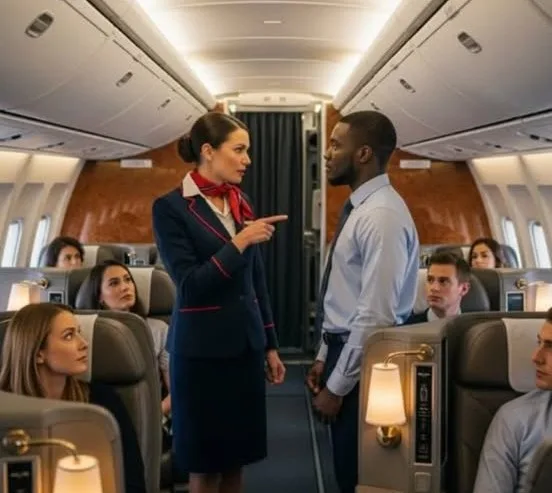
Marcus Ellison adjusted his tailored dark blue suit as he walked through the bustling terminal at Los Angeles International Airport. At forty-two, he had earned an impeccable reputation as a brilliant strategist and was one of the few African-American CEOs at the helm of a successful Silicon Valley technology company.
His schedule was intense: he had just wrapped up a crucial meeting with investors in Los Angeles and was now headed to New York, where he was scheduled to deliver the keynote address at a prestigious economic forum.
Arriving at the gate, he showed his first-class pass with a polite smile. The attendant scanned it, nodded, and let him through. Once inside the plane, Marcus headed to his seat—1A, front row. But as he lifted his briefcase to stow it in the overhead compartment, a flight attendant approached with a tense expression.
„Sir, I’m afraid this seat may have been assigned in error. May I see your boarding pass?”
Marcus handed it over, remaining calm.
„First class, seat 1A,” he confirmed.
The flight attendant checked the ticket again and again before murmuring, „I’m sorry, sir. There’s been a mistake. This seat is reserved. You’ll need to move to economy.”
Nearby passengers began to observe the scene. Marcus, without altering his tone, replied, „With all due respect, this seat was paid for. And it clearly states so on the ticket.”
Another crew member intervened.
„Sir, please move back. We’ll resolve the situation after takeoff.”
Marcus understood instantly. This wasn’t the first time he’d faced this: discrimination disguised as a misunderstanding. He felt his chest tighten, but his voice remained firm.
„I won’t move. If there’s a problem, call the shift manager or the captain. I won’t leave my first-class seat.”
The tension was palpable. Some passengers began discreetly recording with their phones. After a few seconds of hesitation, the crew relented, promising to “clarify the matter later.”
Marcus sat, staring out the window. His heart was pounding, but his face remained serene. He knew everyone was watching him. He couldn’t allow himself to be humiliated—not again, and not in public.
During the flight, the atmosphere was cold. The flight attendants offered him food and drinks with distant courtesy. He watched as other passengers received warm attention, smiles, and conversation; for him, it was only protocol.
Marcus remained focused on his laptop, fine-tuning his presentation for the conference. From the outside, he looked like another busy businessman, but inside, he went over word by word what he would say upon landing.
After six hours, the plane began its descent toward JFK Airport. While passengers collected their luggage, Marcus waited. As he approached the exit, he stopped, turned to the crew, and spoke loud enough for everyone to hear.
“Before you leave, I want to say something.” Today they told me I didn’t belong in the seat I paid for. They tried to move me to economy, despite my first-class ticket. That’s discrimination, and I have all the documentation.

Silence fell in the aisle. Some passengers nodded; they knew he was speaking the truth. Marcus continued, his tone calm but firm:
„I’m Marcus Ellison, CEO of Nexora Technologies. Tomorrow I’ll be on stage at the Global Innovation Summit in front of business leaders and international media. I’m telling this story, not to humiliate, but to show that, even today, professionals of color still face invisible barriers, even though we pay the same price as everyone else.”
The captain tried to intervene.
„Sir, I beg you not to take this to the public…”
Marcus raised his hand.
„I’m not looking for scandals. Just facts. I won’t accept private apologies for a public humiliation. If you want our respect as customers, you must offer us the same respect. It’s that simple.”
A quiet round of applause broke the silence. Some passengers murmured “bravo,” others simply stared in admiration. The crew, motionless, didn’t know what to respond. Marcus nodded briefly, grabbed his luggage, and left without looking back.
The next day, at the Global Innovation Summit in Manhattan, Marcus took the podium. The room was packed: executives, journalists, and officials. His speech was supposed to be about technological innovation, but he began with that experience.
He recounted the events precisely. He didn’t mention the airline or names, but his message was clear: even successful executives face prejudices that have nothing to do with merit or achievements.
“When you look at me, you see a CEO, an innovator,” he said. “But on that flight, you saw a man who ‘didn’t belong’ in seat 1A. And that proves that progress is worthless without respect and equality.”
The room remained silent. The cameras captured every word. Marcus linked his experience to his company’s mission: to create technology that promotes innovation.
New inclusion and equity. His speech became a call not only for innovation, but for social awareness.
Within hours, his story went viral. Attendees shared videos, the media picked it up, and the airline was forced to issue an official statement promising an investigation.
But for Marcus, the most important moment happened behind the scenes. An older businessman approached him and said quietly,
„I’ve flown first class my whole life, and I’ve never feared someone telling me I didn’t belong in my seat. Thank you for opening my eyes.”
That was what Marcus was looking for: not revenge, but awareness. A crack in the wall.
As he left the auditorium, he recalled the moment on the plane when they underestimated him. He smiled. They had thought he would remain silent.
But Marcus had transformed a humiliation into a symbol of dignity. And his story no longer belonged only to him, but to everyone who had ever been treated as if they didn’t belong.
(Fictional story. Any resemblance to real events or people is purely coincidental.)