The bus lurched along the dirt road, a layer of dust clinging to the windows and the late-summer sun bathing the fields in a golden, almost liquid glow. Clara held a faded cloth bag on her lap, clutching it as if it held more than her few belongings: her past, her fear, and her uncertain hope.
At thirty-one, she had resignedly accepted the nickname she’d received in the village: the spinster.
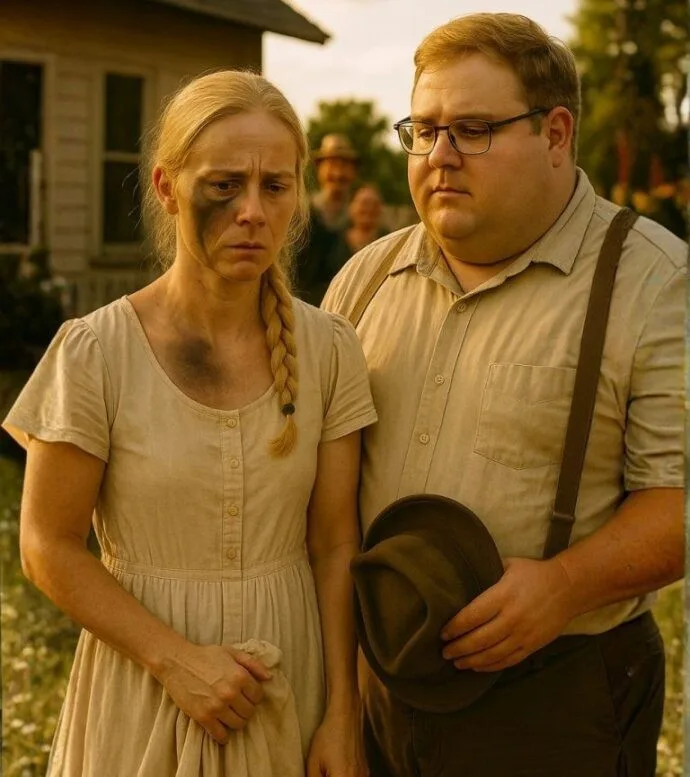
It wasn’t for lack of beauty—her delicate face and serene eyes had a sweetness that inspired calm—but for the dark spot that had run across her cheek and neck since she was a child, a mark that never left her. Children pointed at her, neighbors pitied her, and adults looked at her with that soft, piercing pity that can hurt more than open cruelty.
„You should be grateful someone still loves you,” her aunt had snapped that morning. „Mr. Harold may not be a prince, but he has land, a secure income, and he accepts you just as you are. This is your chance to stop being a burden.”
Clara had bowed her head without responding. Through years in her aunt’s sewing workshop, she had learned that silence was the only possible defense. Now she was being sent—that was the right word—to marry a man she had never met: a farmer who, they said, was tall, slow, and a little clumsy.
When the bus pulled up in front of a modest farmhouse, Clara’s heart leaped. She got out slowly, thin and pale, in her simple cotton dress. A sturdy man with sandy-colored hair and round glasses that drooped down his nose was waiting for her in the yard. His tight shirt and rosy cheeks gave him the look of someone who belongs to the land and understands it

„Miss Clara?” „He asked in a kind, slightly uncertain voice. ‘I’m Harold Turner. Welcome.’
Beside her, a silver-haired woman—her mother, Edith—watched her with a warm smile.
Clara braced herself for the familiar look of repulsion in his eyes. But it didn’t come. Harold stared at her without looking away, with such transparent calm and sincerity that she felt something shatter inside her: it was the first time anyone had ever looked at her like that, as if he’d been waiting for her.
The wedding was simple, without embellishment or pomp. The townspeople were quick to whisper: ‘The woman marked with the fat farmer,’ they said. But Harold’s hand, when he took hers, didn’t tremble. He held it with the firmness of someone who promises more than words can express.
Clara feared disappointment. Yet, day after day, Harold revealed himself to be different. He rose early with the first rooster crow, his laughter filling the barnyard as he worked tirelessly. Despite his heavy frame, he was strong and skillful: he mended fences, fed animals, and lifted impossible loads.
But it wasn’t his strength that moved her most, but his attention. He brought her tea when he noticed fatigue on her face, built shelves if he saw her stretching too much, and one day planted marigolds under the kitchen window just because she’d said she liked them.
Little by little, Clara began to unravel. She revealed her sharp wit, her unexpected jokes that made Harold laugh until he cried, so much so that the rafters of the house seemed to vibrate with her joy. She took care of the accounts, the business, and discovered that her husband had more land and more intelligence than anyone suspected. His modesty wasn’t clumsiness: it was humility.
One autumn afternoon, as the wind stirred the leaves on the porch, Clara dared to ask him:
„Why me, Harold? Why did you choose someone like me?”
He was silent for a moment, then replied in a low but firm voice:
„Because I know what it’s like to be judged by appearances. They see my belly, my clumsy hands, and think I’m simple. When I heard about you, I thought… maybe we were both ready to be truly seen. I wanted someone I could respect. And I respect you, Clara. Every day of my life.”
She felt her throat close. For the first time, her stain didn’t feel like a curse, but a scar that had survived time.
The seasons passed, and their bond grew stronger. Clara was not only a loving wife, but a partner in her work, with ideas that made the farm prosper. Harold, for his part, became her shield: he never allowed anyone to speak cruelly about his wife.
Years later, Clara would fondly remember that first day she crossed the threshold of the house. She had arrived trembling and empty, but she had found more than a roof: she had found a home.
In Harold’s open laughter, in Edith’s serenity, in the daily gestures of silent care, she understood that true love does not seek perfection: it simply sees and allows itself to be seen.
One bright spring morning, she watched her children running through the fields, Harold’s laughter echoing.
I followed them. She brought her hand to her cheek, brushing the stain that had once been her deepest wound.
She no longer saw it as a shame.
It was her story.
And in that certainty, Clara knew she had finally come home.