The night the door closed.
I was nineteen when I found out I was expecting a child.
My father looked at me—or rather, *through me*—and said calmly:
„You’ve made your bed. Now lie down in it.”
Then he turned and closed the door.
The November air stabbed my lungs like a blade. My breath floated before me in streaks of white mist.
I was clutching a duffel bag, wearing a thin coat that didn’t zip up, and beneath my heart was a small life that moved gently, as if to console me.
From the kitchen window, I saw my mother. She was crying, but she didn’t come out.
My brother stood beside her, his arms crossed, smiling, as if he’d just won something.
I didn’t turn around.
Stepping off the porch, I knew that house would no longer be mine.
In our small town community, reputation was everything.
My father—a deacon, a man of strict principles—wore his Sunday best like armor. He quoted the Bible as if it were law, unquestionable. But when misfortune struck his own home, his principles became weapons.
It was then that I understood how empty beautiful words can be if they serve to push someone into darkness.
Work, warmth, and cheap blankets.
Surviving meant working double shifts.
At night, I cleaned offices; during the day, I waitressed.
I rented a small studio apartment where the faucet dripped into a basin and the radiator groaned instead of heating.
I slept under used blankets, warming my baby with my body.
Every movement in my womb was a promise: that life no longer belonged to me alone. It was *ours*.
A thermos and a phrase I never forgot.
One evening in December, my car broke down.
Sitting at the bus stop, I cried.
An older woman, about sixty, sat down next to me. She handed me a thermos of hot tea, touched my knee lightly, and said,
„Honey, God never wastes pain.”
I treasured those words deep in my heart. If pain can be transformed, I thought, even shame can become strength.
Charting a path.
I began listing night classes in the local college catalog.
I applied for scholarships, loans, anything that might offer me an opportunity.
I enrolled in the Officer Reserve program—because the structure was like a ladder to climb.
Every day I told myself: *Have a plan. Stick to it. Don’t stop.*
Emily’s first morning.
My daughter—Emily—was born in a small hospital room.
Still with the bracelet on my wrist, I placed her in a cheap stroller and took her to the neighbor who had agreed to look after her while I worked.
The mornings smelled of burnt coffee and baby powder.
In the college classrooms, the fluorescent light blinded me, but I didn’t complain.
During dawn military training, I learned to move even when I was exhausted.
The people who lifted me up.
In the coffee shop where I worked, a retired sergeant—Walt—left me slips of paper with advice:
how to do push-ups without blisters, how to tie my shoelaces, how to survive.
He called every woman „ma’am”—and that respect stuck with me.
Ruth Silverhair brought flans and never asked questions.
She taught me to hold my head high without asking for mercy.
And the little church between the laundromat and the pawn shop smelled of coffee and hope.
Bills, needles, and little tricks.
Life teetered on the edge.
When the gas bill arrived with the red stamp, I sold my blood to keep them from shutting off the power.
I stretched a roast chicken for three days.
I sewed buttons with dental floss.
At night, I read about resilience and jotted down my thoughts in a spiral notebook.
In the library, near the coin machine, I wrote my motivational letter for the officers’ program.
I clicked „Send” with hands shaking like leaves.
The letter that changed my path.

The reply arrived in the spring.
I held it to my chest and cried—softly, but deeply.
It was the boundary that became a path.
The training broke me and rebuilt me.
I counted steps, breaths, my heartbeat.
I made the bed so straight it could cut through the darkness.
The instructors yelled, I corrected their mistakes and moved on.
Costs and balance.
I didn’t see Emily take the first step—I was on orientation march.
When I missed a signature, I lost the babysitter, but I got her back by bringing soup and apologizing.
Some nights, the porch came to mind.
Others, sleep flowed like a clear wave.
Insignia and child at my side.
When I received the rank of officer, the uniform rested on my shoulders like a promise.
Emily applauded in a little blue dress from the flea market.
I sent my mother a photo with a short message: *We’re safe. Everything’s fine.*
I don’t write
I looked up to my father.
My pride still hurt.
The army became a springboard.
I learned to drive carefully, because every mistake mattered.
Over time, my pain stopped being a wound—it became an engine.
Sunrises and lists of checked off tasks built peace around me.
A phone call in December.
The years passed.
Emily collected library cards and made collages with them.
One day she called my mother.
„Your father isn’t well,” she said softly.
„We’ll come. Mark drives.”
I stood in the kitchen for a long time and wrote one word: *Family.*
I crossed it out. Then I wrote it again.
I called Emily.
„Do you want them to come?”
„I want to start over,” I replied. „We’ll see the end later.”
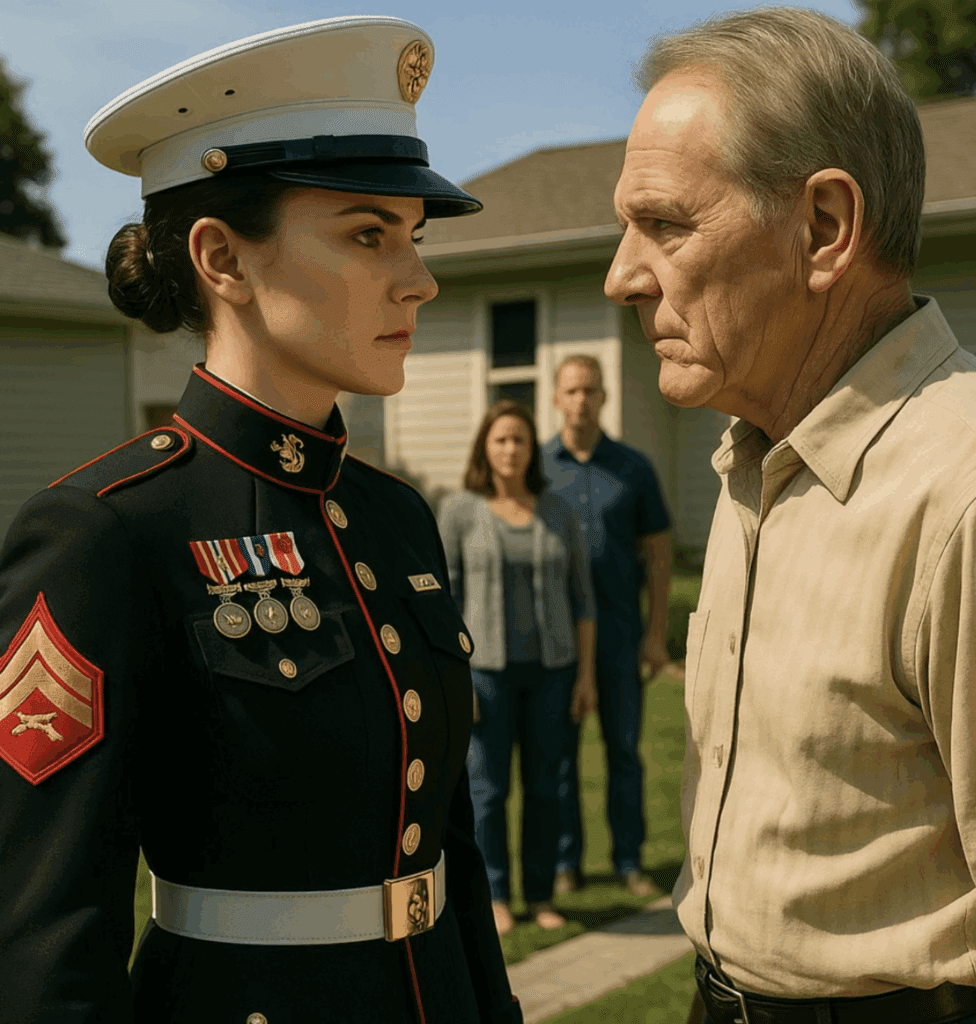
SUV in front of the gate.
The morning was clear and cold.
Albert, our caretaker, had arranged poinsettias near the door.
My mother came out, wrapped in a shawl from another life.
Mark stood stiffly, as if still seeking our father’s gaze.
My father came out last. He was smaller than I remembered.
„General,” he said in an inadequate tone.
„Thank you for coming,” I replied.
A room full of witnesses.
The tree lights were flashing inside.
My life had gathered around the table: Walt with a box of cookies, the chaplain—now a friend—a few cadets, neighbors who knew that sometimes a small gesture is enough to save someone.
My father spoke in a voice I didn’t recognize.
„I was cruel. I thought I was defending principles. I was wrong.
The chaplain called this „a new kneeling.”
It wasn’t a confession—it was a beginning.
You can’t fix twenty years in an afternoon.
Forgiveness isn’t a switch, it’s an exercise.
We ate ham and eggs. We told old stories, laughing at the wrong times.
Mark admitted that he’d often chosen comfort over courage.
My mother confessed to putting her hand on the window that night—she was looking for me in the dark.
„I was scared,” she said.
And Emily walked among us, handing out envelopes that read:
First the truth. Then tenderness.
The departure was different.
When they left, the sky turned pink.
My father said, „I don’t deserve it.”
„Let’s try,” I replied.
Albert wrote in his notebook: Reconciliation continues.
Magnolia and shadow.
A few years later, my father asked if he could plant a magnolia in front of the house.
„Something sweet, for others to sit under,” he explained.
We dug together. Planting is a form of hope, buried before the eyes of the world.
What memory does not lose.
Sometimes at night I still see the porch light.
It hasn’t disappeared. But next to it, there’s another—the one I created myself.
Mercy wasn’t easy. It became my daily choice.
The last lesson.
Many years later, in uniform at the town ceremony, the magnolia tree stretched wide and proud.
Someone said, „It must be a special feeling—seeing your son follow his own path.”
I thought of the woman at the bus stop, the thermos, Ruth and her pies.
Driving isn’t a podium—it’s a backup plan and a helping hand to those in need.
Silent justice.
My father died in the winter. The funeral was simple and sincere.
The veterans lined up, neighbors brought food, Mark read a few sentences and sat down.
We planted a second magnolia. Half laughing, half crying, we told stories—as families do.
I don’t tell this story to talk about pain.
I tell it because it’s true:
A rejected daughter built her life and then met the father who had to see who she had become.
When she met my gaze, she didn’t see anger—she saw peace. And the people who taught me what strength truly is.
Because justice doesn’t always scream.
Sometimes it’s like a table set for someone who once closed the door on you.