The Will That Changed Everything
When their father’s estate was finally settled, the brothers expected to find an unexpected fortune. But the notary uttered a single sentence that left them stunned: all the assets—the company, the house, the accounts—remained in their mother’s name.
Their father had written that this decision honored the woman who had built everything by his side and who now, after a stroke, lived with limited mobility.
That night, the brothers exchanged sharp, venomous words, more hurtful than any shout.
The next morning, their plan was ready, disguised as a „walk for some fresh air.” Their mother, wrapped in a scarf and with a thermos of tea on her knees, was placed in her wheelchair.
A Road of No Return
They drove to the outskirts, where the train tracks stretched straight and silent, ignored by travelers and recognized only by birds. The sky was metallic gray; the air smelled of iron and rain.
“We’ll stop here for a moment,” the older brother said, his voice gentle. “Listen to the wind, Mom.”
The younger brother glanced at his watch.
Steel, Silence, and Prayer
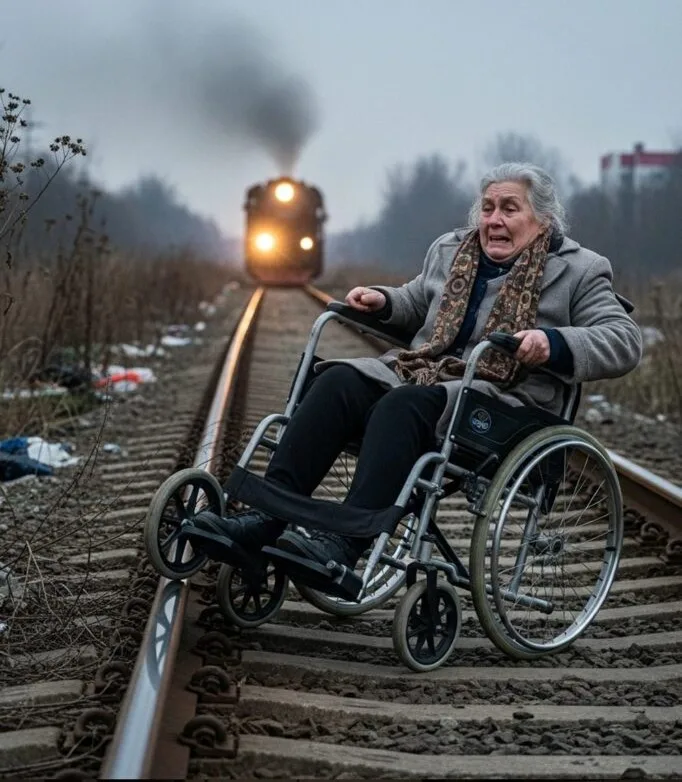
The wheelchair’s front wheels jammed between the wooden slats. The siblings’ faces became expressionless masks. In the distance, a whistle blared, long and deep.
Mila, as everyone called her, felt the vibration in her bones. She tried to free the chair; her fingers trembled, failing. Hot tears mingled with the icy air.
“If you’re there,” she whispered, “don’t let me go like this.”
The Camera No One Saw
A kilometer away, in a low building, a railway technician named Anatoly watched blurry monitors. A gust of wind rattled the door. On screen 7, a square of pale fabric, a human shape on the tracks, caught his eye.
He leaned forward. A wheelchair.
Her hand flew toward the radio:
„Dispatch, Junction House Three. Obstruction on track 2, km 19. Possible person. Initiating emergency protocol.”
The freight train engineer saw the red light and pulled the emergency brake. Steel screamed; the cars shuddered; physics collided with compassion.
The first to arrive
Two workers, Anya and Petrov, ran through the gravel. Anya knelt, holding the wheels; Petrov inserted a bar under the frame.
„On the count of three!”

„One… two…”
The chair didn’t budge.
Anya did the only thing she could: she unbuckled the seatbelt, hugged Mila, and pulled hard. Petrov held the legs. They staggered backward just as the chair tipped sideways onto the rocks.
The train passed a moment later; Mila’s scarf floated down and landed on the rail like a flag at half-mast.
The Price of Panic
Sirens, footsteps, voices. Police and paramedics rushed in. An officer knelt beside Mila:
„Ma’am, you’re safe. We have you.”
Two men stood by the side of the road, watching. Seeing their mother alive, something broke in their faces. They turned away.
„Freeze,” the officer ordered, showing the video.
The cameras had recorded everything: the car’s arrival, the placement of the wheelchair, the siblings walking away. The evidence was irrefutable.
The Clause the Father Never Mentioned
The notary arrived with a marked copy of the will:
„There was a clause your father valued highly,” he said. „An heir who harms the testator automatically forfeits the inheritance. The assets pass beyond him.”
Activated. The legal trap closed on the greedy.
A Trial Without Victory
Weeks later, Mila was in the courtroom, wearing her scarf. Anya and Petrov were with her; Anatoly watched from the back.
The siblings didn’t look up. The judge declared:
„You have forfeited your right to the inheritance. The assets remain with Mrs. Voronina and will later go to a foundation in her name.”
The Time She Had Left
Mila recovered slowly, accumulating small victories each day. She returned to the numbers, the order, and the kindness that had built the family business.
Her first public act was not vengeful: she organized a luncheon on the platform and presented medals to those who had saved her.
„You were strangers,” she said, „and yet you were family when I needed you most.”
Then she founded the Junction Fund, dedicated to railway safety, assistance for the elderly, and scholarships for artisans.
Epilogue: The Rails at Dusk
Some evenings, she would ask the driver to stop at kilometer 19. She would listen to the distant whistle and the clinking of the rails, not to relive the fear, but to honor the place where despair transformed into courage.
Greed drove her children to the brink; strangers brought her back. Between these two truths, a chain of small acts of mercy stretched like tracks toward the horizon, proof that what we do in the last second can define us forever.